Showing posts with label Birds. Show all posts

Sunday, May 9, 2010

Rohrdommel und Weidehopf


Rohrdommel


Weidehopf


If you don't know what these mean, they are referred to as the bittern and the hoopoe in English, respectively. If you're wondering why I put this in the "Märchen" category, it is because this story attempts to explain how these birds got their calls... By the way, I know the bittern is not the exact species being referred to, possibly the hoopoe as well, but I got them from the general grouping area in Wikipedia.

'Wo weidet Ihr Eure Herde am liebsten?' fragte einer einen alten Kuhhirten. 'Hier, Herr, wo das Gras nicht zu fett ist und nicht zu mager; es tut sonst kein gut.' 'Warum nicht?' fragte der Herr. 'Hört Ihr dort von der Wiese her den dumpfen Ruf?' antwortete der Hirt, 'das ist der Rohrdommel, der war sonst ein Hirte, und der Wiedehopf war es auch. Ich will Euch die Geschichte erzählen.
Der Rohrdommel hütete seine Herde auf fetten grünen Wiesen, wo Blumen im Überfluß standen, davon wurden seine Kühe mutig und wild. Der Wiedehopf aber trieb das Vieh auf hohe dürre Berge, wo der Wind mit dem Sand spielt, und seine Kühe wurden mager und kamen nicht zu Kräften. Wenn es Abend war und die Hirten heimwärts trieben, konnte Rohrdommel seine Kühe nicht zusammenbringen, sie waren übermütig und sprangen ihm davon. Er rief 'bunt, herüm, (bunte Kuh, herum), doch vergebens, sie hörten nicht auf seinen Ruf. Wiedehopf aber konnte sein Vieh nicht auf die Beine bringen, so matt und kraftlos war es geworden. 'Up, up, up!, schrie er, aber es half nicht, sie blieben auf dem Sand liegen. So gehts, wenn man kein Maß hält. Noch heute, wo sie keine Herde mehr hüten, schreit Rohrdommel 'bunt, herüm,' und der Wiedehopf 'up, up, up!'

Where do you like best to feed your flocks, said a man to an old cowherd. Here, sir, where the grass is neither too rich nor too poor, or else it is no use. Why not, asked the man. Do you hear that melancholy cry from the meadow there, answered the cowherd, that is the bittern. He was once a cowherd, and so was the hoopoe also, I will tell you the story. The bittern pastured his flocks on rich green meadows where flowers grew in abundance, so his cows became wild and unmanageable. The hoopoe drove his cattle on to high barren hills, where the wind plays with the sand, and his cows became thin, and got no strength. When it was evening, and the cowherds wanted to drive their cows homewards, the bittern could not get his together again. They were too high-spirited, and ran away from him. He called, come, cows, come, but it was of no use. They took no notice of his calling. The hoopoe, however, could not even get his cows up on their legs, so faint and weak had they become. Up, up, up, screamed he, but it was in vain, they remained lying on the sand. That is the way when one has no moderation. And to this day, though they have no flocks now to watch, the bittern cries, come, cows, come, and the hoopoe, up, up, up.

There it was. I find it a little surprising that the hoopoe knows English, but...

Anyway, I don't have the exact species for reference, but I have heard the American Bittern call, and it sounds quite similar to the onomatopoeia given here, I don't have a point of reference for the Hoopoe, though.


Original Text from http://gutenberg.spiegel.de/?id=12&xid=969&kapitel=228&cHash=882d0f037arohrdomm
Translation from http://www.familymanagement.com/literacy/grimms/grimms195.html

Sunday, January 31, 2010

Gray Jay


Well, this is another bird I have a personal story about, but this one is a lot more extensive than the Anhinga story. Anyway, you have heard of the Blue Jay, but what about the Gray Jay? If you’re not in Canada or the Rocky Mountains, or at least near the Canada Border, then I doubt you’ve seen one. It says that this bird lives in the forest. There was a forest near the area, so I’d believe that. It also says that the Gray Jays use sticky saliva to stick food to trees to eat later. Okay, let me ask you this. Have you ever heard of a Dark-Eyed Junco? They tend to come in the winter in this area and forage for seeds. If you have seen them, you notice that they search with fervor. Well, these birds are similar, they are also foragers, but they aren’t migratory. In addition, these birds are relatives of the crow. They are clever and could be considered tame, in the respect that they don’t fear humans. This picture says enough…


Picture from http://thebirdguide.com/washington/photos/IMG_3186_gray_jay.jpg


(It’s from Wikipedia and this is a bolder Gray Jay)
Gray Jays, as stated before seem to classify us as a source of food. They don’t eat us, but they know that we often have food. I had to deal with these things in the cold of Okpik, a lake near the Minnesota-Canada Border which was frozen at the time. Well, I saw at least two of those things when I was there, we were near some trees, so that may be part of it. Anyway, we could not leave food unattended from the camp robbers, when we left food alone, they were on it. They even swooped down and snatched a cracker from someone’s hand and didn’t notice until later.

Saturday, January 23, 2010

Fish Crow


Picture from http://www.dpughphoto.com/images/fish%20crow%20ocracoke%2050906.JPG

I would guess you have seen a crow before. This particular kind of crow might live around where you live for all I know. However, it doesn’t live here, so I’ll write about it. This particular kind of crow only lives on the Atlantic Ocean and Gulf of Mexico coast in the United States. As this crow is related to the American Crow, the kind of crow that seems familiar, it has a similar diet, changed only by the fact that, because it lives primarily in areas with edible marine life, it tends to eat the marine life mentioned in the comment. This is the reason it has the name “Fish Crow,” if it wasn’t obvious already. When you see this bird, it will look very much like an American Crow, however, the way to set them apart is their call. I am sure that you have all heard the American Crow in your lifetime, if you live in the United States or the southern part of Canada, that is. Well, the Fish crow has a different call, more nasal. Some people have told me it sounds like it is sick. If you want to find this call, go here. http://www.allaboutbirds.org/guide/Fish_Crow/id

I wish I could say more about this bird, but I can’t, so I have to leave this at this point for now.

Sunday, January 10, 2010

Anhinga


Picture from http://www.geometer.org/costarica/anhinga.jpg

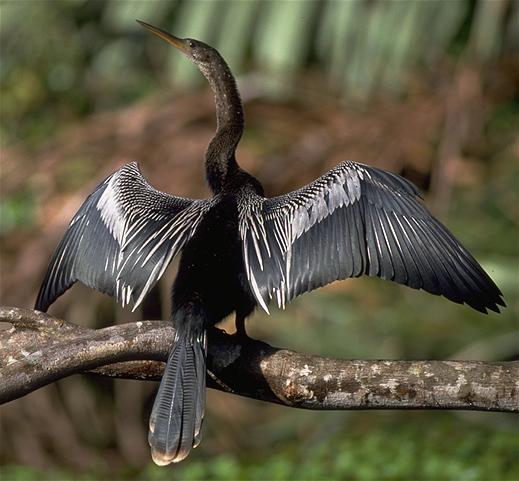
When you hear the name “Anhinga,” I would guess that it might not click with you, at least if you live in the Midwest. This is because they are not found in the Midwest, they are found in the Southeast, assuming you’re in the US, anyway. If you look at a complete range map, you will find that they are in Coastal Central America and a lot of Northern South America. If you look on the Cornell website, it won’t tell you much, it will give you the range map, though. You do see that it lives in the Marsh area, which could describe quite a few places in Florida, which is the only place I’ve seen it. Its diet is fish, typical of a bird in that area. It creates a nest out of shrubs, also good for that area and to get its food, it does surface diving, where, of course, it dives from the surface of the water. However, something makes this surface diver different from others. Have you ever heard the phrase “water off a duck’s back,” it means to take things in stride, but it came from the special coating that ducks have that prevents their feathers from getting wet. Unlike most surface divers, Anhingas don’t have that coating. For birds that eat fish that don’t have the covering, like the bald eagle, they can either use their talons to snatch it from the top of the water or take it from another bird. I bet that you doubt an Anhinga could do either of those by just looking at its picture, but you do notice something else, its wings are spread out. This bird can not get water off with oil like the duck can, so it fans its wings to dry them off instead.

The anhinga has another name “the snake bird.” If you look at it, its neck does make it look somewhat snakelike. When we went on the trip, my mother looked outside and thought, she saw a snake, it was an anhinga, we all know about birds, by the way, so she knew what an Anhinga was.

I’m not sure if this post was very good, but I needed a topic… but I think I did well considering how bad it could have been.

Tuesday, December 15, 2009

Magnificent Frigatebird


I know that this post should have been made last week, but we needed a new modem at our house, so...yeah.


I have decided to start talking about birds again. The first one is a bird I have never seen before and never may, primarily because it is a pelagic bird.


This bird lives in the tropical Atlantic area, breeding in areas aroung the Caribbean. This bird is also called the Man O'War for "its rakish lines, speed, and aerial piracy of other birds." (Source from Wikipedia)


Now, if you looked at that carefully you noticed the word "aerial piracy." True, the Magnifacent frigatebird is a pirate, like other friagtebirds. However, for now, we will just talk about the Magnificent frigatebird.


One other out of place fact, this bird is said to vagrant in Europe, which means some birds can be found there, but don't expect larger amounts.


Anyway, they are about 100 cm tall with a 215 cm wingspan, the measurements came in centimeters.


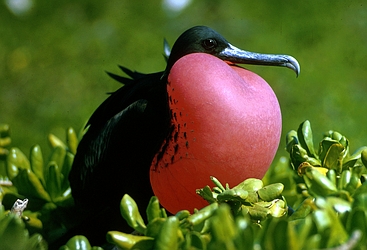
As you saw from the picture. The bird has a large red pouch, if you did not see this, look at the picture again, if you looked at it before...


Anyway, this pouch has one purpose, to attract mates and it is inflated during breeding season. The male is the only one with this pouch. The female looks similar to it, only it has no pouch and some other differences.


This bird is similar to other frigatebirds in size, except for the Lesser Frigatebird.


Now, about the aerial piracy. Although this is where they get their alternate name from, this is not where they primarily get their food from.


As for feeding in general, they do steal some food, but they catch the rest themselves. Unlike most pelagic birds, they can not take off from water, so they need to catch things in the air like eagles do.
I can't really say much more excpt that these birds are genetically close to pelicans.

Thursday, September 24, 2009

Crows can recognize Human Faces

NPR, National Public Radio, recently reported that crows are able to tell humans apart. For some of you, this may come as a complete shock, others may have already heard about it, others yet may have felt that they have known this all along. John M. Marzluff from the University of Washington decided to do an experiment. He noticed that crows seemed to recognize certain people in the more urban area and cawed at them often, but in an area where there were more guns, they stayed there distance. Marzluff wanted to see if crows actually did recognize people, so he tagged some crows around campus while wearing a caveman mask, then asked his students to wear the mask around campus for a while. Whenever crows saw them, they started cawing at the person wearing the caveman mask. Not just the ones that were tagged, but others around campus as well. Just to see whether it was something about the mask itself, Marzluff also decided to have people wear a Dick Cheney mask around. Various humans had reactions to this, but the crows had none. Something that helps add evidence was that sometimes the caveman mask was worn upside down. When this happened, the crows turned upside-down in flight, then started cawing at the caveman mask. Marzluff guesses that crows do this because some humans feed them, while others try and hurt them. Okay, crows can recognize humans and tell themselves apart. We can recognize other humans, but its harder to tell crows apart. I am challenging you to try and tell these crows apart. You will be given a photo of a crow, you can study it as long as you want, then you try and pick it out from 5 other crow photos at a different angle. You will be tested 3 times, so do you think you can do it? Let's see.... http://www.npr.org/templates/story/story.php?storyId=111040421
P.S. By the way, this is a comment someone left about the story. It isn't very meaningful, but it is entertaining :
This just in from WCRO-FM, National Crow Radio…The humans are at it again. This week a couple of their best and brightest reported to Robert Krulwich of National Public Radio, that several studies have determined that we crows do a remarkable job of telling humans apart from one another. Puullleeezzze. They seem completely surprised that as their “white coated" ones invade our nests and attach rather unattractive bling to our young, we mark them as one of our Most Wanted. We then quickly spread that information to our flock and friends through our scream, squawk and dive-bomb system. Granted, sometimes we are a bit over zealous, but, have you seen those bracelets? These same scientists have also found, in less formal research, that we all look alike to them. Big surprise! How do they think that we’ve been able to successfully exist among them for so long? Of course we can tell you apart and no, we’re not telling you our method. For any humans that might be spying on us through this radio broadcast, listen up. We know where you live, where you bank, where you grocery shop and best of all, where you get your car washed. No masks with scary faces worn upside down or even backward are going to fool us. So don’t mess with us. We’ve been here longer than you for good reason. My fellow Crows, keep up the fine work. Continue to identify invaders with shock and caw, and, hope that one day soon, our diplomatic efforts will allow us to co-exist more peacefully.

Saturday, September 19, 2009

Diatryma

Now, I will discuss my favorite prehistoric bird, the Diatryma. Like the Eohippus, this animal is also known by a different name, Gastornis. This change is not as bad as that of Eohippus, so I will not delete comments referring to the Diatryma as “Gastornis.” In case you are wondering, I got all the names I prefer to call these animals now from an older book. I am staying static in what I like to call these animals. By the way, Diatryma has the same situation as Eohippus. Someone named Gaston Planté discovered the first fossils and named it after himself “ornis” means bird, “ornithology” is the study of birds. Anyway, later in America someone named Edward Drinker Cope found a more complete skeleton and named it Diatryma, ancient Greek for canoe. Okay, the name isn’t very flattering, but still. Just because he found it second?! The second skeleton was more complete anyway! By the way, I changed my mind; all comments with Diatryma’s bad name will also be deleted. My rage is possibly also attributed to two things: One, they used to call it Diatryma, and they didn’t change it to the Bad name until during or after the late 20th century. Second: MY BELOVED EOHIPPUS IS IN THE SAME SITUATION!!!!!! Anyway, now that my rage has mostly faded, I will talk about the Diatryma in more detail. The Diatryma was flightless, large, and fast, just like an ostrich with short wings and a parrot-like beak. Might I add I am getting information from an article, http://www.suite101.com/article.cfm/paleontology/85674 , which calls it the Diatryma FROM 2001! Why did they make this ridiculous name change idea!? According to this article, the Diatryma was a member of the order Gruiformes, which currently encompasses quite a few waterbirds, like cranes. But some other sources place the Diatryma in the ratite group, like ostriches. It is debatable whether Diatryma was a predator or not. Its hooked beak could have been used for tearing flesh or hard leaves, similar to Triceratops. Currently, it is more widely assumed that Diatryma was a predator. A random final note, no one knows what Diatryma feathers look like. They are assumed to be similar to ostrich feathers, like hairs, but what they are truly like is unknown…unknown…unknown...